

The spiritual high of Yom Kippur has barely begun to settle when the hammering starts. Across the Land of Israel, families are breaking their fasts, cars are just beginning to return to streets that stood empty for 25 hours—and already, the first sukkahs begin going up.
Metal poles clatter in courtyards and on balconies. Bundles of bamboo mats and schach appear strapped to car roofs. In some neighborhoods, nearly every available balcony and courtyard seems to acquire temporary walls; elsewhere, sukkahs pop up more sporadically, tucked between apartment buildings and storefronts. Supermarkets fill their shelves with Sukkot supplies and decorations. Lulav and etrog stands spring up on sidewalks and in shopping centers. Children cut decorations, families haul tables and chairs outside, and the banging and building continue.
For a few frenetic days, the landscape of Israel changes as Sukkot takes shape.
Israel’s Chabad-Lubavitch emissaries are building, too; from Tel Aviv to Masada, from hospitals to army bases, each building the sukkah where their local Jews will feel at home.
In Tel Aviv’s Old North, a leafy residential neighborhood of cafés, boutiques and Bauhaus-lined streets, that means filling a giant sukkah with art—creating a space familiar and intriguing enough to draw in the people passing by.
An Art Gallery Beneath the Schach
For some 15 years, Rabbi Menachem Hecht, director of Chabad of Northwest Tel Aviv, has erected what has become known as the “Art Sukkah.”
It is difficult to miss.
At more than 100 square meters—more than 1,000 square feet—the Chabad House bills it as the largest sukkah in Tel Aviv. Built outside the Chabad center on Yehoshua Bin Nun Street, its walls become an exhibition of Jewish artwork, including images inspired by Chassidic and Kabbalistic ideas. Throughout the holiday, the sukkah serves not only as an attraction, but as a functioning community mitzvah-lounge, open to anyone who wants to come inside, make a blessing on the sukkah, or shake the lulav and etrog. The unusual design was deliberate.
“We wanted something both interesting and inspiring,” Hecht said, “something that would draw people walking past to stop, look and come inside.”
On the bustling streets of Tel Aviv, sometimes a step through the sukkah door can feel like a portal to a new dimension. Last Sukkot, Rabbi Hecht noticed a man slowly walking past, while a farbrengen was underway inside.
While the man didn’t seem like the type you’d find at a Chassidic gathering, Hecht welcomed him in, and encouraged him to join. That first encounter developed into an ongoing relationship and regular Torah study.
“His whole life changed,” Hecht said. A year later, he describes the man as being in “a totally different place.”

For Hecht, there is a message in the sukkah’s temporary walls themselves. Sukkot, the “season of our rejoicing,” asks a Jew to leave the apparent security of his permanent home and spend a week in a temporary dwelling—a reminder, Hecht says, that happiness doesn’t ultimately come from possessions.
“Nothing we own will be with us forever,” he said. “It’s all temporary. It is a gift from G‑d. But the real gift is being in His embrace, and the sukkah walls remind us that. Like a hug. It gives us true joy, knowing that whatever may come and go, we will always be in G‑d’s hands.”
Hundreds of kilometers away, at the lowest point on earth, Rabbi Shimon Elharar is preparing a sukkah for an entirely different kind of neighborhood.
His has nearly 50,000 visitors.

‘The Festival Sukkah’ Beneath Masada
Each Sukkot, tens of thousands of Israelis descend on the Dead Sea region for the Tamar Festival, several nights of outdoor concerts set against the dramatic Judean Desert landscape.
The performances take place at night, when the desert heat subsides, with Masada illuminated above the festival grounds.
Each performance draws some 7,000 to 8,000 people, Elharar says, with nearly 50,000 attending over the course of the festival.
And among the festival infrastructure is a designated sukkah.
For roughly a decade, Elharar, Chabad emissary to the Dead Sea and Masada region, has worked with the festival organizers and regional council to erect a large sukkah inside the festival grounds. It is incorporated into the festival’s official plans, and a week before the event, festival staff help Rabbi Elharar put it up.
They call it simply “Sukkat HaFestival” (“The Festival Sukkah”).
Before the crowds arrive, tables and chairs are brought in, lighting is installed inside and outside, and a large sign identifies the sukkah.
For Elharar, its location carries particular meaning. Some 2,000 years after the tragic destruction and fall of the Jewish community at Masada, thousands of Jews are once again gathering at its foot—this time to celebrate.
“Precisely here, we give expression to the fact that the children have returned to their borders, that Am Yisrael chai [‘the nation of Israel lives’],” Elharar said. “I think it is an expression of rebirth.”

Building a sukkah in the Judean Desert, however, presents problems that most sukkah-builders never have to consider. Daytime temperatures during construction can approach 50 degrees Celsius, or 122 degrees Fahrenheit. Elharar recalls leaving the air-conditioning running in a nearby vehicle so that the crew could retreat inside every 15 minutes or so, cool down and head back out to work.
Then there is the wind. Powerful desert gusts mean the structure has to be carefully anchored into the ground so that the sukkah remains firmly in place. To Elharar, the effort is worthwhile.
“When you look at it with a vision of what is good for the Jewish people, even 50 degrees is OK,” he said. “We’ll make the effort and do something good for the Jewish people, because Am Yisrael deserves to rejoice and to have a Jewish experience that is beautiful and pleasant.”
And the sukkah gets used. Elharar doesn’t have an exact count of how many festivalgoers enter each night, but many leave with more than just a bite to eat. Elharar’s contact information is posted inside the sukkah, and over the years, he has received calls from visitors moved by finding it there.
“It’s not something to take for granted,” he recalls people telling him. “It’s moving to see that even in the middle of the desert, in a place where it seems there's nothing, suddenly—wow! There’s a beautiful sukkah, fully kosher, spacious and lit up at night! Somebody cares about us.”
For Israelis accustomed to encountering Chabad Houses while traveling in Thailand, India, Nepal and other far-flung destinations, Elharar sees something familiar in the reaction. The Dead Sea is one of Israel’s great tourism destinations, and here, too, a Jew discovers that a sukkah is waiting for them.

A Sukkah for Every Jew
The giant Art Sukkah in Tel Aviv and the Festival Sukkah beneath Masada could hardly look more different.
But the thinking behind them is remarkably similar: Build the sukkah that meets the Jews who are there. Across Israel this week, thousands of variations on that idea are taking shape.
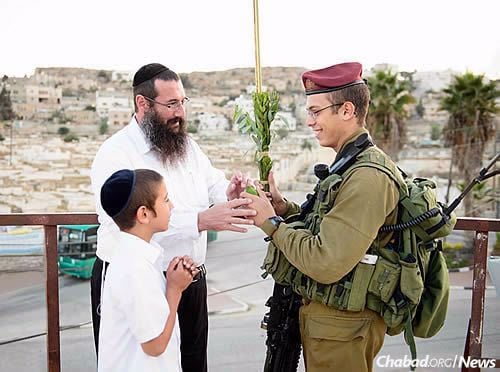
At hospitals throughout the country, Chabad emissaries affiliated with Lev Chabad are preparing sukkahs and holiday activities for patients, relatives and medical staff—Jews who may have expected to spend Sukkot at home and instead find themselves beside a hospital bed. Chabad emissaries serving the Israel Defense Forces will bring Sukkot to soldiers who cannot leave their bases and posts, traveling with sukkahs and sets of lulav and etrog. In cities and towns, public sukkahs are going up outside Chabad Houses and in busy commercial areas.
And then there are the mobile ones.

During the weekdays of Sukkot, Israelis have learned to keep an eye out for sukkahs turning up in unlikely forms: perched on truck beds, towed through the streets, attached to bicycles and, in Tel Aviv, even rolling through the city around a Chassid on rollerblades.
For Elharar, the reason for making all that effort is simple.
“We have such a good, such a special people,” he said. “They’re worth making the effort for. This wonderful, special Jewish people deserve for us to do something good for them. That’s my motivation.”
It is an outlook, he says, that comes directly from the teachings of the Rebbe—Rabbi Menachem M. Schneerson, of righteous memory.
“The Rebbe educated us to help and to love every Jew,” Elharar said, citing the Hayom Yom’s teaching that a person should have a taavah—a deep craving—to do something good for another Jew.
“You don’t know them; they don’t know you. It doesn’t matter. They’re a Jew.”
And from one end of Israel to the other, Chabad emissaries are fulfilling that calling, working to make sure that Jews, wherever they may be, can step inside and experience the sukkah’s G‑dly embrace.






Start a Discussion