

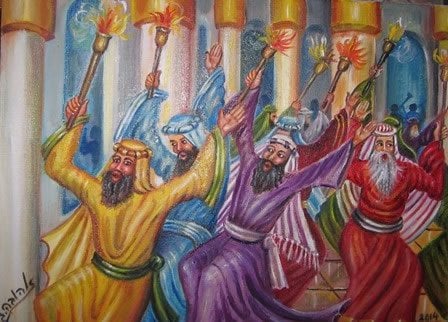
Young priests climbing towering golden lamps to kindle flames so bright they illuminated all of Jerusalem. The greatest rabbis of the Jewish people dancing with blazing torches. A celebration so extraordinary that the Sages declared that whoever had not witnessed it had never truly experienced joy.
This was Simchat Beit Hashoevah, the joyous celebration surrounding the water libation in the Holy Temple during Sukkot.
As explicitly prescribed in the Torah, throughout the year wine libations accompanied the animal sacrifices brought on the altar in the Temple, along with flour offerings. The water libation of Sukkot, however, is found only in the Oral Torah, transmitted to Moses at Sinai and passed down from generation to generation. To emphasize the Jewish people’s unwavering belief in the Oral Torah, the Sages instituted an extraordinary celebration to accompany the drawing of the water, transforming it into one of the most joyous occasions of the year and an awesome sight to behold.
The original celebrations of Simchat Beit Hashoevah, described extensively in the Mishnah and Talmud, came to an end with the destruction of the Second Temple in the year 69 CE.
Yet walk into any of the thousands of synagogues around the world on the nights of Sukkot today, and you will still find Jews dancing and rejoicing in celebrations bearing the same name.
In the Crown Heights section of Brooklyn, home to the headquarters of the Chabad-Lubavitch movement, as well as in Jewish communities worldwide, these celebrations take on an even greater dimension. The dancing spills out of the synagogues and into the streets, often continuing until the early hours of the morning.
But it wasn’t always this way. This is the story of how that tradition began.
Remembering the Temple
Much of Jewish life to this day remains centered on the Holy Temple, the historic and spiritual heart of the Jewish people. Simchat Beit Hashoevah is no exception. Today’s celebrations are equally an expression of the joy of Sukkot, known as “the time of our rejoicing,” and a remembrance of the extraordinary festivities that once took place in the Holy Temples of Jerusalem.
The custom of holding dedicated celebrations featuring singing, dancing and, at times, flaming torches gained popularity over the past several centuries. In the 18th century, the renowned scholar and author Rabbi Chaim Yosef David Azulai (1724-1807), known as the Chida, wrote a letter from Jerusalem describing the celebrations he witnessed in Jerusalem. Other accounts from the same period document similar festivities.
As the Jewish population in the Land of Israel grew, the tradition continued to flourish. During the intermediate days of Sukkot, an increasing number of synagogues and Chassidic courts began hiring bands, with participants dancing joyously to the music.
Outside the Holy Land, Simchat Beit Hashoevah celebrations also took place, although they sometimes assumed a different form. In the court of the Rebbes of Chabad-Lubavitch, these celebrations generally took the form of a Chassidic farbrengen, a gathering in the Sukkah where words of Torah and inspiration were shared over l’chaim and refreshments. These gatherings, too, had a special character, infused with the heightened joy of the holiday.

A new dimension was added sometime after the marriage of the future Rebbe, Rabbi Menachem M. Schneerson, of righteous memory, to Rebbetzin Chaya Mushka, of righteous memory, daughter of the Sixth Rebbe, in 1929. Spending the month of Tishrei at the court of his father-in-law, the future Rebbe would lead the Simchat Beit Hashoevah farbrengens, sharing a wealth of Torah insights in his distinctive style. This was particularly remarkable given his otherwise reserved nature and tendency to keep to himself throughout the rest of the year. He personally recorded several of these farbrengens in notes that were discovered after his passing and published as part of the Reshimot.
The farbrengens continued after the Rebbe arrived in America in 1941. During this period, he directed them primarily toward yeshivah students from non-Chabad backgrounds, tailoring his teachings to an audience with little prior exposure to the study of Chassidut.
After the Rebbe assumed the leadership of the Chabad movement in 1950, following the passing of his father-in-law, these gatherings grew dramatically, drawing crowds that packed the Sukkah to capacity. By the mid-1960s, the overcrowding had become so severe that the Rebbe discontinued farbrengens in the Sukkah.
One notable exception came in 1976, when the Rebbe held a special farbrengen in the Sukkah for Jewish children attending public schools.

New Beginnings
Then came Sukkot of 1980. It was a year of Hakhel, which follows the sabbatical Shemitah year, when the Torah commands all Jews to gather at the Holy Temple to hear the king of Israel read from the Torah. In the weeks leading up to the holiday and during the opening days of the new year, the Rebbe repeatedly emphasized the theme of Hakhel, calling for Jewish gatherings to commemorate this biblical commandment. The year thus began with an atmosphere of heightened excitement.
On the first night of Sukkot, following the evening prayers, the Rebbe surprised the thousands gathered at 770 Eastern Parkway, Chabad-Lubavitch headquarters, by delivering an unexpected talk.
The Rebbe spoke about the Simchat Beit Hashoevah celebrations in the Holy Temple, noting that they began only on the second night of Sukkot to avoid any possibility of violating the holiday. Yet the very destruction of the Holy Temple, which had brought those magnificent celebrations to an end, also made it possible to expand the celebrations beyond their original limitations and begin the rejoicing on the very first night of the holiday.
As the Rebbe concluded his talk and prepared to leave the synagogue, he began singing “Atah Vechartanu,” encouraging the crowd to join in. All of the gathered responded enthusiastically. After his departure, many remained to dance and celebrate, rejoicing in the holiday and the special significance of the Hakhel year.
Eventually, the dancing came to an end, and the customary program of Chassidic farbrengens resumed.

The following night, this same scene repeated itself. The Rebbe delivered yet another surprise talk, this time calling for an even greater increase in joy. Spirited dancing again followed in the synagogue.
The two days of the holiday were followed immediately by Shabbat, and on Friday night, the Rebbe once again delivered an unannounced talk. By now, however, the unexpected was becoming expected. Again, the Rebbe called for greater rejoicing, and again, the congregants responded enthusiastically.
This time, the celebration took a new turn. The dancing, until then confined to the walls of the synagogue at 770 Eastern Parkway, spilled out onto the street, as several yeshivah students began dancing on the sidewalk. Within a short time, their numbers had grown to dozens.
No one seems entirely certain who took the next step, but someone began leading the dancers around the corner and down Kingston Avenue, the Jewish neighborhood’s main shopping drag. As they danced the crowd grew, making its way down the street, block by block. At the corner of Montgomery Street, the celebration moved into the roadway. By this time hundreds had joined the dancing, and before you knew it a NYPD police car had arrived to block the street to traffic.
The dancing continued for hours.

The following night, followed what had quickly become a familiar pattern. This time, however, with the first two days of the holiday and Shabbat over and the intermediate days of Sukkot underway, musical accompaniment was permitted. The dancing began right away at the corner of Kingston Avenue and Montgomery Street.
Zalmon Jaffe, an English businessman and Chassid who chronicled his visits to 770 in his distinctive, often humorous style, recorded the night’s events in his diary:
At about midnight, [my granddaughter] Yenta Chaya came dashing into our apartment, breathless and excited. She gasped out that thousands of people were singing and dancing in the streets and we should come quickly. In addition, it seemed that Ellie Lipsker, our internationally famous Lubavitch “Showman” had become so carried away with all the excitement, he became so inspired with joy and Simcha, that he spontaneously brought out his accordion. He was joined by two brothers, who normally gave concerts professionally. They brought their drums, saxophones and trumpets. They set up their stand at the corner of Kingston Avenue and Montgomery Street. A microphone was installed—and night was turned into day. The police even diverted the traffic.
The extraordinary scenes soon attracted attention well beyond Crown Heights. As another contemporary account recorded in Kfar Chabad Magazine described it:
The very idea of dancing in the streets was foreign to American sensibilities. One can easily imagine, then, how much surprise, as well as joy, it brought to local residents. Even one of America’s major radio stations saw fit to announce that “Lubavitcher Chassidim are dancing in the streets!” As a result, many visitors came from other parts of New York to witness the Lubavitchers’ Simchat Beit Hashoeva for themselves.”
By the following night, fueled by the Rebbe’s continued calls for greater joy, the live music and dancing was continuing well past 4:00 in the morning.

‘Until the Streets Dance’
The next year, 1981, the celebrations continued in much the same fashion. The Rebbe delivered a talk on each night of Sukkot exploring the unique significance of each day, particularly its connection to the ushpizin, the celestial guests who visit our Sukkahs each night of the holiday. He drew lessons from each of these guests, from Abraham to King David, as well as from the daily portions of Psalms and the section of the weekly Torah reading corresponding to that particular day.
And, of course, the Rebbe spoke about joy. Night after night, he urged the Jewish people to rejoice with ever-greater intensity, each time explaining why that night called for an even greater celebration than the one before.
By then, the street where the dancing took place was already being closed to traffic on the very first night of Sukkot, with celebrations continuing each night of the holiday.
As the years went by, the Rebbe continued to call for ever-greater joy. The Rebbe explained that the joy could not remain confined to oneself, or even to one’s home, Sukkah or synagogue. It had to burst forth, uplifting not only one’s immediate surroundings but even the world outside becomes a part of the celebration. On several occasions, the Rebbe declared that the rejoicing must reach the point where “the street itself dances.”
And that’s what happened.
The people danced and danced. Accompanied by musicians and singers, in balmy weather and under pouring skies, they took to the streets every night of Sukkot. What had begun as an impromptu celebration became an annual event, drawing tens of thousands of locals and guests from throughout New York and around the globe.
From New York, the celebrations spread across the United States and onward to Israel, Europe, Australia and wherever Jews can be found.
In Crown Heights, the celebration remains an event unlike any other. With the cooperation and assistance of the relevant authorities and the NYPD, the music begins at nightfall and continues until 6:00 in the morning.
And wherever Jews gather, Sukkot is an opportunity to revisit the Rebbe’s teachings for each night of the holiday, explore the unique significance of that day and translate those teachings into action, dancing with such boundless joy that, in the Rebbe’s words, “the street itself dances.”




Start a Discussion